Rick and Josie’s falling-out
Klara and the SunRick and Josie’s falling-out is the break that turns their childhood intimacy into an absence neither can readily repair. A conversation about Rick’s uncertain prospects at Atlas Brookings exposes the conflict beneath their shared plans: Josie imagines a future in which they remain together, while insisting that Rick’s mother is preventing him from becoming an adult. Rick answers not with an argument but by writing on Josie’s picture; her shocked response sends him out of the house, and his visits—and their bubble game—stop.
Causes and Background
The rupture grows out of a disagreement about the future they had imagined together. Josie tells Rick that he has a chance of attending Atlas Brookings because he is clever, but Rick counters that the institution admits unlifted students at a rate of less than two percent. The smallness of that possibility makes his prospective future feel less like a plan than a remote exception, especially as the two consider what their different social positions would mean for their relationship.
Josie attributes Rick’s lack of advancement to his mother’s wishes. She argues that his mother never went ahead with him because she wanted to keep him for herself, and now it is too late. Later, she renews the accusation in more personal terms: Rick’s mother does not want him to leave home and become an adult. The narration gives this as Josie’s interpretation, not as a confirmed account of his mother’s motives. Rick resists discussing it and asks what difference the wider society makes, insisting that it need not interfere with anything between them. Josie replies that it does interfere with their plan.
That plan is not fully spelled out, but Josie frames its difficulty as a difference between them: she will have “society” and Rick will not. She brings her mother’s decisions into the argument, contrasting the courage it took to go ahead with Josie after Sal with the obstacle she sees in Rick’s mother’s choice. The reference connects the dispute about Rick’s future to Josie’s own family history, while making clear that she regards courage and decision as decisive where Rick sees little reason to discuss the matter.
The Confrontation
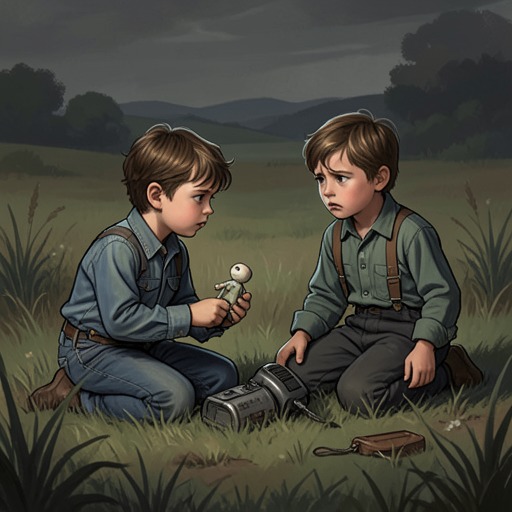
The argument takes place while Josie and Rick are making pictures. Even after announcing her view of his mother, Josie continues adding to her drawing; Rick sits silent, gazing at it. The ordinary activity gives way to a sudden, physical response when he leans forward and writes directly on the picture, using his thigh as support rather than a magazine. The page begins to crinkle as he writes quickly.
Rick does not hand the sheet to Josie. He tosses it onto the duvet in front of her, drops his sharp pencil, and backs toward the doorway, watching her with an expression described as angry and fearful. Josie sets down her own pencil and reads what he has written. Her first response is disbelief and hurt: she cannot believe he would write it and asks why he would do so. The content of the message is not disclosed in this account, so the scene establishes the act and its effect without resolving exactly what Rick wrote.
The encounter ends abruptly. Klara, who has been present on the Button Couch, turns around when the tension seems too great to leave the two alone. Rick appears startled by her movement; after looking at her with the same fear and anger, he walks out without speaking. The sound of his steps going downstairs and the front door closing marks the end of the visit. Josie then throws the things off the bed and lies down on her front, as if the encounter had ended like any other—an outwardly casual gesture set against the rupture that has just taken place.
Separation and Aftermath
Rick does not return the next day or the day after. When Melania Housekeeper asks where he has gone and whether he is sick, Josie only shrugs and says nothing. Her silence leaves the break unexplained to the household and offers no sign that she and Rick have made up.
As the days pass without a visit, Josie grows quieter and gives signals that she wants to be left alone. She continues drawing in bed, but without Rick and their bubble game her enthusiasm quickly drains away. She often throws unfinished pictures onto the floor, stretches out on the bed, and stares at the ceiling. The change is visible not only in what she says but in what happens to the activity they once shared: the pictures remain, but the play that gave them a purpose has disappeared.
Klara offers to take Rick’s place in the bubble game, proposing that Josie draw and she supply suitable words. Josie rejects the substitution. She does not mind Klara listening, she says, but Klara cannot do it instead of Rick. The refusal makes the game’s relational meaning plain: it is not simply an activity that another companion can reproduce. Rick’s absence cannot be filled by repeating its outward form with someone else.
Significance
The falling-out changes the emotional meaning of the shared drawings and bubble game. Before the rupture, these activities belonged to the routine of Rick’s visits; afterward, the drawings become unfinished, are discarded, or are gathered by Klara rather than completed through play. Josie’s rejection of Klara’s offer confirms that the bond carried by the game is specific to Rick, even as the argument shows how difficult it has become for the two children to imagine a common future.
The account withholds the precise words Rick writes and does not establish whether Josie’s accusation about his mother is true. Instead, the rupture is conveyed through a sequence of observable changes: a message on a picture, Rick’s fearful and angry retreat, repeated days without his return, and Josie’s dwindling interest in the activities they shared. That movement from a private disagreement to a sustained absence gives the break its consequence: the plan they had spoken of is left obstructed, while their closeness persists for Josie chiefly as something that cannot be replaced.